Forum Replies Created
-
AuthorReplies
-
in reply to: ENSO Research #228783
2025: Super El Niño events drive climate regime shifts with enhanced risks under global warming
Climate regime shifts (CRSs), characterized by abrupt and persistent transitions between alternative stable states in the climate system, pose serious threats to ecosystems and human well-being. Understanding the potential drivers of CRSs is crucial, particularly in a warming world where CRSs are becoming more frequent. Here, using multiple observations and model simulations, we find that the likelihood of CRS occurrence significantly increases in the context of super El Niño events due to their remarkable climate perturbations. This higher probability is detected across various climate elements, such as surface air temperature, sea surface temperature, and surface soil moisture. In addition, we suggest that this boost effect of super El Niño events on CRSs will be greatly amplified under future greenhouse warming. Our findings underscore a deeper and more persistent climate footprint of super El Niño events, suggesting that early warnings and proactive measures are crucial for mitigating their escalating risks. https://www.nature.com/articles/s41467-025-66143-7
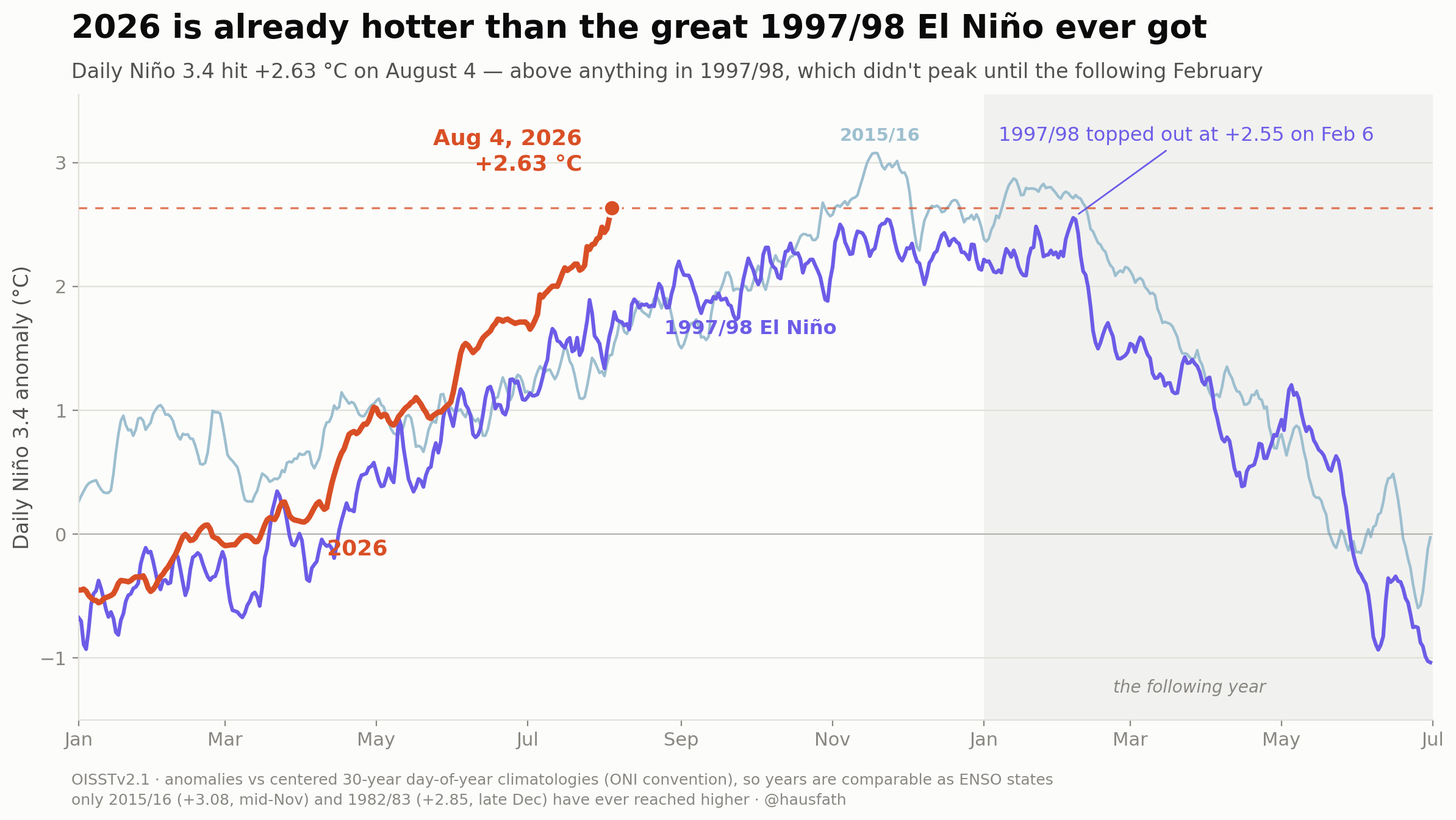
in reply to: El Niño 2026 #228778Zeke Hausfather@hausfath@fediscience.org: The rise in Niño 3.4 region sea surface temperatures over the past few weeks has been nothing short of astonishing.
We are now hotter than any days during the 1997/1998 super El Niño event, and we are still many months from the peak.

https://mastodon.social/@hausfath@fediscience.org/117044969281811054
in reply to: Antarctic Ice Sheet Deglaciation #228650Beneath Antarctica’s ice, a fiery future may await
Researchers probe volcanoes’ response to a changing world
Antarctica is a land of not only ice, but fire. More than 100 volcanoes hide beneath the ice sheet or poke through it. One, 3800-meter-high Mount Ere- bus, seethes menacingly just 40 kilo- meters from McMurdo Station, Antarctica’s biggest research base. Another, Mount Waesche, has yielded unsettling hints that ice loss triggered its ancient eruptions. Now, researchers are targeting both peaks to learn about immediate and long- term threats.
[..]
Waesche, meanwhile, though dormant and possibly extinct, may offer an answer to the most pressing question in Antarctic volcanology: With ice melting ever more quickly, will the volcanoes grow more active? The idea is simple: As the weight on the volcanoes is lifted, the gases trapped in magma are released like the fizz in an uncorked bottle of champagne, driving eruptions. Such a dynamic has been seen with volcanoes in Iceland and the U.S. Pacific Northwest, says Adelina Geyer, a volcanologist at Geo-sciences Barcelona. “As soon as glaciers start to retreat, volcanic activity starts to increase.”But no evidence of the interplay has been recorded in Antarctica. Last decade, an NMT team made the arduous trip to Waesche, some 1500 kilometers from McMurdo, and sampled lavas from when it was last active, more than 100,000 years ago.
Laboratory analyses, as yet unpublished, revealed the rocks came from more than 50 different eruptions, nearly 90% of which occurred between ice ages, when temperatures were warm, like today’s—and when ice sheets were presumably thin. “It was a totally unexpected correlation,” Zimmerer says.
This month, the researchers will return to Waesche, looking for more rocks that could confirm whether the loss of overlying ice caused Waesche to wake up. The team hopes to visit other volcanoes in the upcoming years to explore their response to ice melt.
Zimmerer says it’s unclear how fast volcanoes would respond to shrinking ice, if at all. And one volcano erupting under the ice wouldn’t cause much extra melting. But if many erupted, he says, a feedback loop could take hold, with ice loss leading to more volcanism, and more eruptions to more ice loss and consequent sea-level rise. If so, humanity’s greenhouse gas emissions can even affect the planet’s most remote volcanoes which could in turn impact humanity’s fate. https://www.science.org/doi/pdf/10.1126/science.adv0708
in reply to: El Niño 2026 #228572The “Super” El Niño of 2026: Why 2027 Will Be the Year the World Watches
A rapidly intensifying patch of warm water in the central Pacific is reshaping global weather patterns, potentially disrupting food supplies across multiple continents, and pushing global temperatures toward territory humanity has never measured. On June 11, 2026, NOAA’s Climate Prediction Center issued an El Niño Advisory, marking the official onset of conditions that forecasters warn could rank among the strongest in the instrumental record. https://earthclimate.eu/2026/07/17/the-super-el-nino-of-2026-why-2027-will-be-the-year-the-world-watches/
-
This reply was modified 3 months, 1 week ago by
 EARTH CLIMATE.
in reply to: Thwaits Glacier #228494Rift propagation signals the last act of the Thwaites Eastern Ice Shelf despite low basal melt rates
Cambridge University Press: 19 September 2024
Rift propagation, rather than basal melt, drives the destabilization and disintegration of the Thwaites Eastern Ice Shelf. Since 2016, rifts have episodically advanced throughout the central ice-shelf area, with rapid propagation events occurring during austral spring. The ice shelf’s speed has increased by ~70% during this period, transitioning from a rate of 1.65 m d−1 in 2019 to 2.85 m d−1 by early 2023 in the central area. The increase in longitudinal strain rates near the grounding zone has led to full-thickness rifts and melange-filled gaps since 2020. A recent sea-ice break out has accelerated retreat at the western calving front, effectively separating the ice shelf from what remained of its northwestern pinning point. Meanwhile, a distributed set of phase-sensitive radar measurements indicates that the basal melting rate is generally small, likely due to a widespread robust ocean stratification beneath the ice–ocean interface that suppresses basal melt despite the presence of substantial oceanic heat at depth. These observations in combination with damage modeling show that, while ocean forcing is responsible for triggering the current West Antarctic ice retreat, the Thwaites Eastern Ice Shelf is experiencing dynamic feedbacks over decadal timescales that are driving ice-shelf disintegration, now independent of basal melt. https://www.cambridge.org/core/journals/journal-of-glaciology/article/rift-propagation-signals-the-last-act-of-the-thwaites-eastern-ice-shelf-despite-low-basal-melt-rates/B9E07E795F2C543EC7812E12C3DF65A9
in reply to: ENSO Research #2284912014: Increasing frequency of extreme El Niño events due to greenhouse warming
El Niño events are a prominent feature of climate variability with global climatic impacts. The 1997/98 episode, often referred to as ‘the climate event of the twentieth century’, and the 1982/83 extreme El Niño, featured a pronounced eastward extension of the west Pacific warm pool and development of atmospheric convection, and hence a huge rainfall increase, in the usually cold and dry equatorial eastern Pacific. Such a massive reorganization of atmospheric convection, which we define as an extreme El Niño, severely disrupted global weather patterns, affecting ecosystems, agriculture, tropical cyclones, drought, bushfires, floods and other extreme weather events worldwide. Potential future changes in such extreme El Niño occurrences could have profound socio-economic consequences. Here we present climate modelling evidence for a doubling in the occurrences in the future in response to greenhouse warming. We estimate the change by aggregating results from climate models in the Coupled Model Intercomparison Project phases 3 (CMIP3) and 5 (CMIP5) multi-model databases, and a perturbed physics ensemble. The increased frequency arises from a projected surface warming over the eastern equatorial Pacific that occurs faster than in the surrounding ocean waters, facilitating more occurrences of atmospheric convection in the eastern equatorial region. https://www.nature.com/articles/nclimate2100
2020: How Does El Niño–Southern Oscillation Change Under Global Warming—A First Look at CMIP6
The latest generation of coupled models, the sixth Coupled Models Intercomparison Project (CMIP6), is used to study the changes in the El Niño–Southern Oscillation (ENSO) in a warming climate. For the four future scenarios studied, the sea surface temperature variability increases in most CMIP6 models, but to varying degrees. This increase is linked to a weakening of the east-west temperature gradient in the tropical Pacific Ocean, which is evident across all models. Just as in previous generations of climate models, we find that many characteristics of future ENSO remain uncertain. This includes changes in dominant time scale, extratropical teleconnection patterns, and amplitude of El Niño and La Niña events. For models with the strongest increase in future variability, the majority of the increase happens in the Eastern Pacific, where the strongest El Niño events usually occur.
Plain Language Summary
The El Niño–Southern Oscillation (ENSO) is a naturally occurring irregular oscillation in the tropical Pacific Ocean alternating between warm (El Niño) and cold (La Niña) phases every 2–7 years. The sea surface temperature anomalies associated with ENSO are linked to variability in key climate quantities, such as temperature, winds, and precipitation over many parts of the globe. Hence, it is of great scientific and societal interest to determine how ENSO may change in a warming climate. We find that the latest generation of climate models shows changes in ENSO in a warmer world. The future variability is increasing, especially in the eastern equatorial Pacific, where the extreme warm events usually occur. This increase appears to be related to a reduced temperature difference between the eastern and western equatorial Pacific. The global weather patterns influenced by both the warm and cold events will also change, but models disagree on how large these changes will be. https://agupubs.onlinelibrary.wiley.com/doi/10.1029/2020GL090640
in reply to: ENSO Research #2284902022: More frequent central Pacific El Niño and stronger eastern pacific El Niño in a warmer climate
El Niño events exhibit rich diversity in their spatial patterns, which can lead to distinct global impacts. Therefore, how El Niño pattern diversity will change in a warmer climate is one of the most critical issues for future climate projections. Based on the sixth Coupled Model Intercomparison Project simulations, we report an inter-model consensus on future El Niño diversity changes. Central Pacific (CP) El Niño events are projected to occur more frequently compared to eastern Pacific (EP) El Niño events. Concurrently, EP El Niño events are projected to increase in amplitude, leading to higher chances of extreme EP El Niño occurrences. We suggest that enhanced upper-ocean stability due to greenhouse warming can lead to a stronger surface-layer response for increasing positive feedbacks, more favorable excitation of CP El Niño. Whereas, enhanced nonlinear atmospheric responses to EP sea surface temperatures can lead to a higher probability of extreme EP El Niño. https://www.nature.com/articles/s41612-022-00324-9
in reply to: ENSO Research #2284882024: Deep ocean warming-induced El Niño changes
The deep ocean, a vast thermal reservoir, absorbs excess heat under greenhouse warming, which ultimately regulates the Earth’s surface climate. Even if CO<sub>2</sub> emissions are successfully reduced, the stored heat will gradually be released, resulting in a particular pattern of ocean warming. Here, we show that deep ocean warming will lead to El Niño-like ocean warming and resultant increased precipitation in the tropical eastern Pacific with southward shift of the intertropical convergence zone. Consequently, the El Niño-Southern Oscillation shifts eastward, intensifying Eastern Pacific El Niño events. In particular, the deep ocean warming could increase convective extreme El Niño events by 40 to 80% relative to the current climate. Our findings suggest that anthropogenic greenhouse warming will have a prolonged impact on El Niño variability through delayed deep ocean warming, even if CO<sub>2</sub> stabilization is achieved. https://www.nature.com/articles/s41467-024-50663-9
2024: Emergent climate change patterns originating from deep ocean warming in climate mitigation scenarios
The global oceans absorb most of the surplus heat from anthropogenic warming, but it is unclear how this heat accumulation will affect the Earth’s climate under climate mitigation scenarios. Here we show that this stored heat will be released at a much slower rate than its accumulation, resulting in a robust pattern of surface ocean warming and consequent regional precipitation. The surface ocean warming is pronounced over subpolar to polar regions and the equatorial eastern Pacific where oceans are weakly stratified to allow vigorous heat release from the deep ocean to the surface layer. We also demonstrate that this ocean warming pattern largely explains changes in the precipitation pattern, including the southward shift of the Intertropical Convergence Zone and more moistening in high latitudes. This study suggests that deep ocean warming may hinder climate recovery in some regions, even if carbon neutrality or net negative emissions are successfully achieved. https://www.nature.com/articles/s41558-024-01928-0
in reply to: Antarctic Ice Sheet Deglaciation #228432Excerpt of Barclay Kamb’s 1990 talk on Antarctic disintegration, and the prospects of rapid developments. At around 56:00, he mentioned water pressure, basal melt, till and speed of ice-stream flow – could be of the order of decades.
https://dai.ly/xaoxe0yFor full talk https://archive.org/details/capsca_000155
-
This reply was modified 3 months, 1 week ago by
-
AuthorReplies